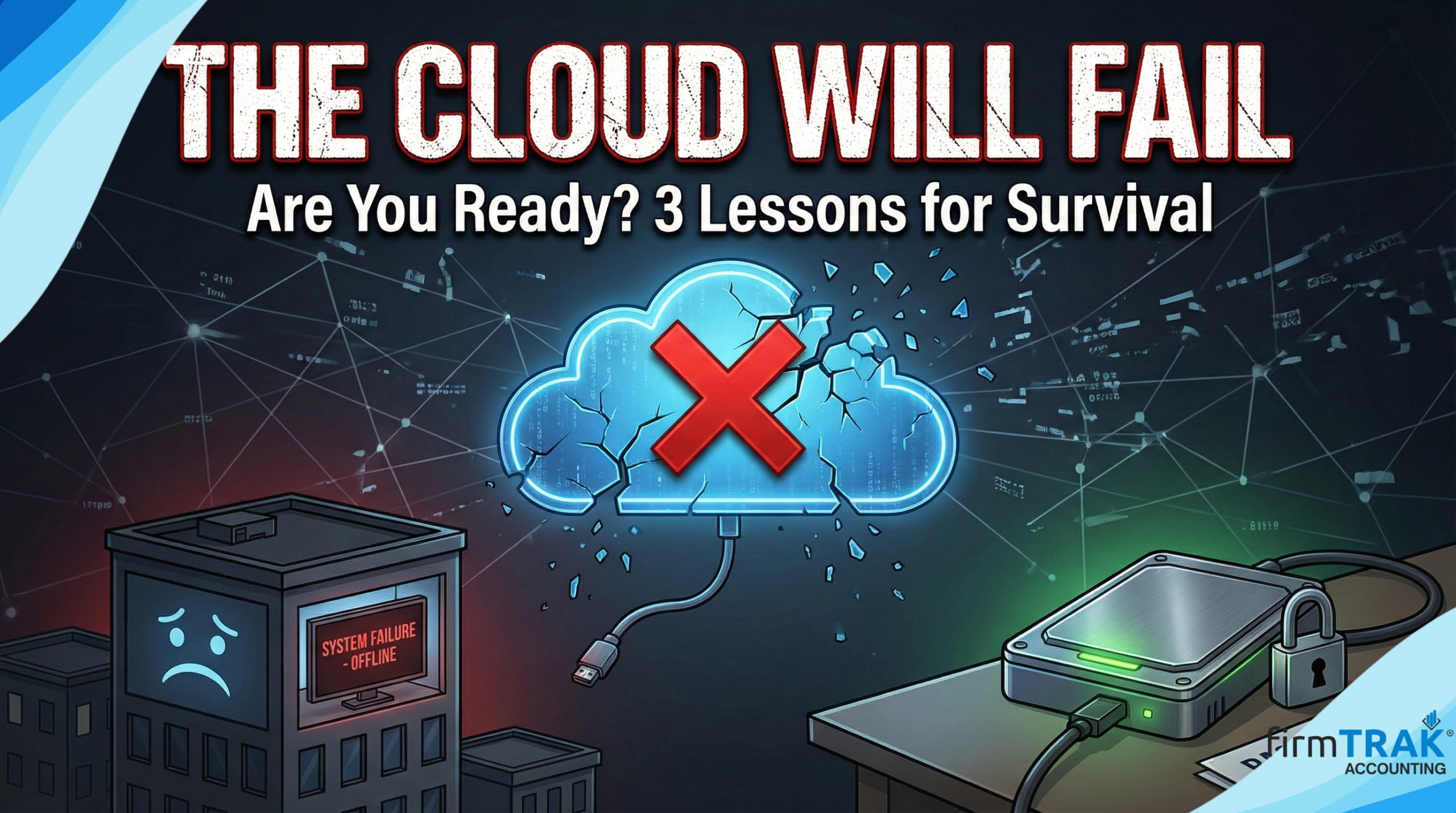
The Cloud Will Fail: 3 Lessons from the Annual Outage You Can’t Afford to Ignore

1. Introduction: The Familiar Feeling of Digital Disconnection
It’s a feeling that has become as predictable as the seasons: you try to access a critical file, log into a service, or launch an application, and nothing happens. A quick search reveals the culprit—a major cloud provider like Amazon Web Services (AWS) is experiencing a massive outage, and a significant portion of the internet has gone down with it. It’s a “Groundhog’s Day” scenario that plays out annually, reminding us of the fragility of the digital infrastructure we depend on.
While these events are often short-lived, they serve as a powerful, real-world stress test for our data safety strategies. The purpose of this article is not just to rehash the news of another outage but to explore the critical, and often counter-intuitive, lessons these disruptions teach us. For any business, especially small ones, understanding these takeaways is essential for building true digital resilience.
2. Takeaway 1: “99% Uptime” Still Means Your Business is Closed for Three Days a Year
Cloud service providers love to advertise impressive uptime statistics like “99%,” which sounds nearly perfect. However, when you translate that percentage into actual business hours, the picture becomes far more alarming. A standard full-time work year consists of 2,080 hours. A 99% uptime guarantee still leaves 1% of the year—or over 20 hours—as potential downtime.
For a small business, 20 hours of being unable to access core systems, client data, or operational tools is a critical vulnerability. To put it in more practical terms, that’s the equivalent of being completely shut down for nearly three full workdays. When your entire operation relies on these cloud-based backbones, even a statistically small outage can have an outsized impact on your productivity and bottom line.
3. Takeaway 2: Your Only Real Safety Net is an Offline Backup
The core lesson from these recurring outages is that relying solely on one type of system, no matter how robust it seems, introduces a single point of failure. The most effective strategy to counter this risk is simple and timeless: back up your key files and systems to an external drive that is not connected to the internet.
This isn’t just a recommendation for the non-technical; even Carin, one of the firm’s partners who works daily with cloud-based systems, noted that she immediately turned to a backup system during the outage. This proactive mindset is becoming more critical as major tech companies push users deeper into cloud dependency. For instance, with the rollout of Windows 11, Microsoft makes it increasingly difficult for users to store files locally instead of on OneDrive. This default setting makes a conscious, manual offline backup strategy more essential than ever.
For professional organizations like law firms, this strategy is doubly important. It not only protects the immense amount of hard work already invested in client matters and cases but also preserves the strict confidentiality that clients depend on, keeping sensitive information insulated from widespread internet disruptions.
4. Takeaway 3: The Experts Are Surprised It Doesn’t Break More Often
The architecture of the modern internet is surprisingly fragile. A vast ecosystem of businesses, from small startups to global enterprises, often relies on a single provider like AWS. This consolidation of services means that one failure can have a cascading effect across the entire digital landscape. According to a recent Wired article on the subject, the real surprise isn’t that these outages happen, but that they don’t happen more frequently.
As one analysis noted, the experts behind these massive platforms have a sobering perspective on their own creations:
“their sort of overall theme of their article was they’re surprised it doesn’t happen more often. So take that for what it’s worth that a mega corp like Microsoft and AWS. They’re like, I’m surprised it’s up as much as it is, but it shouldn’t have taken them as long to fix it as it as it did.”
This insight is a stark reminder for small businesses. The issue isn’t just that the cloud can fail, but that recovery can be unpredictably slow. If the very architects of our digital world are surprised by its stability and critical of its recovery time, relying on their systems without a personal safety net is not just a risk—it’s a gamble.
5. Conclusion: Use Downtime as a Wake-Up Call
Ultimately, these annual outages should be treated as more than just a temporary inconvenience. Each disruption is a free, real-world fire drill—a valuable opportunity to see where your vulnerabilities lie. Instead of waiting for the next crisis, use this latest outage as a catalyst to “reevaluate your plans.” This reevaluation should also include a call to your insurance provider to understand what, if any, coverage you have for business interruptions caused by third-party outages.
By understanding the real-world meaning of uptime percentages and embracing the simple security of an offline backup, you can protect your business from the inevitable moments when the cloud fails. Ask yourself a simple question: If the cloud disappeared for a week, would your business still be standing?

A Senate Report Used AI to Predict a Job Apocalypse. Here Are 5 Takeaways You Can’t Ignore.

Introduction: The Elephant in the Room is an Algorithm

Public and professional discourse is saturated with curiosity, excitement, and a palpable sense of anxiety about the impact of artificial intelligence on the future of work. Will AI create a new era of prosperity, or will it render millions of jobs obsolete? While much of this conversation has been speculative, a recent, explosive report from the U.S. Senate Health, Education, Labor and Pensions (HELP) Committee has added a concrete and alarming forecast to the debate.

In a move of profound, almost poetic irony, the committee leveraged OpenAI’s own technology to forecast its societal impact. By directing ChatGPT to analyze federal job descriptions across the entire U.S. economy, they generated a stark headline prediction: artificial intelligence and automation could destroy 97 million U.S. jobs within the next decade. This finding, derived from the very technology reshaping our world, sets a serious stage for a conversation about what comes next. Here are five critical takeaways from the report that demand our attention.

——————————————————————————–

1. The Sheer Scale of the Prediction is Staggering

The core finding of the Senate report is its sheer magnitude. The ChatGPT-based model predicted that AI and automation could replace 97 million jobs over the next ten years. The authors arrived at this figure by having the AI analyze tasks detailed in the federal government’s Occupational Information Network (O*NET). This “meta” approach—using AI to forecast its own impact—lends a unique and sobering weight to the conclusion. However, the report’s authors offer a critical caveat, stating, “The reality is no one knows exactly what will happen…it represents one potential future in which corporations decide to aggressively push forward with artificial labor.”

The displacement is not predicted to be evenly distributed. The report identifies specific occupations facing extreme levels of disruption, including the potential replacement of 89% of fast food and counter workers, 83% of customer service representatives, and 47% of heavy and tractor-trailer truck drivers. The report underscores the gravity of this shift, noting that traditional advice for displaced workers may no longer apply in this new paradigm.

“Artificial labor could not only put millions of people out of work from their existing job. It could also replace new jobs that could have been created. A factory worker who loses their job cannot be told to learn to code if artificial labor also takes the coding job.”

——————————————————————————–

2. It’s Not Just Blue-Collar Anymore

A key takeaway from the report is the profound impact on white-collar professions, challenging the long-held assumption that automation primarily threatens manual or repetitive blue-collar tasks. The analysis includes jarring predictions for historically secure professions, signaling that the digital moat protecting cognitive labor from automation has been breached.

The report forecasts the potential replacement of 64% of Accountants and Auditors, 54% of Software Developers, and 47% of General and Operations Managers. This aligns with warnings from industry leaders who see AI making significant inroads into cognitive, rather than purely physical, labor, particularly at the entry level.

In May, Dario Amodei, the CEO of the main competitor to OpenAI’s ChatGPT, Anthropic, warned that AI could lead to the loss of half of all entry-level white-collar jobs, spiking unemployment to 10 to 20% in one to five years.

——————————————————————————–

3. Companies Are Saying the Quiet Part Out Loud

The Senate report provides compelling evidence that corporations are not just passively adopting AI for marginal efficiency gains; they are actively and openly pursuing it as a strategic tool for labor cost reduction. A review of investor transcripts, financial filings, and corporate presentations reveals a clear intent to substitute human workers with “artificial labor.”

The report highlights several striking examples of this trend:

  • AI company Artisan AI is explicitly advertising its services with the slogan to get companies to “stop hiring humans.”
  • Self-driving truck company Kodiak directly states its goal is to address challenges like “high labor costs.”
  • Another autonomous vehicle firm, Aurora, lists the advantages of its technology as including “no workers compensation” and “no ongoing driver training.”

This strategic shift is visible at the highest levels of corporate America. Giants like Amazon, which posted 59.2 billion in profits**, have laid off **27,000 people** since 2022 while its former Web Services CEO made **34.3 million. Walmart, which posted 19.4 billion in profits**, has cut **70,000 jobs** over the last five years. And JPMorganChase, with **58.5 billion in profits, says it expects to cut 10% of operations staff in the coming years. This explicit strategy of replacing human labor to boost efficiency and cut costs is not happening in a vacuum; it is the radical acceleration of an economic divergence that has been widening for half a century.

——————————————————————————–

4. This Isn’t a New Problem—It’s a Massive Escalation

The threat of AI-driven job displacement is not an entirely new phenomenon but rather a dramatic escalation of a long-term economic trend. For decades, the economic benefits of technological advancement and increased productivity have not been broadly shared with the American workforce. The Senate report frames the AI revolution as a dangerous accelerant to this existing and growing inequality.

The report’s Executive Summary cites a critical statistic that defines this decades-long divergence: Since 1973, worker productivity has surged by 150% and corporate profits have grown by over 370%, while real wages for the average American worker have actually decreased by nearly $30 a week.

Furthermore, the report notes that from 1987 to 2016, the rate of jobs lost to automation began to outpace the rate of new job creation, reversing a historical pattern where technology created more jobs than it destroyed. The current wave of AI technology threatens to hyper-accelerate this already negative trend, potentially turning a slow bleed of jobs into a hemorrhage.

——————————————————————————–

5. Not Everyone Sees a Dystopia (But Caution is Key)

To provide a more balanced perspective, it’s important to note that not all forecasts are as dire as the Senate report’s. A World Economic Forum report, for instance, offers a more optimistic outlook, estimating that AI will create a net 78 million new jobs globally—based on a churn of 92 million roles eliminated and 170 million created—by 2030.

This more nuanced view is shared by some in the business community. In a discussion of the Senate report, the consulting firm firmTRAK Solutions suggested the predictions are “a little more scary than I think that it actually will be.” From their small-business perspective, AI is more likely to be a tool that augments human workers, allowing companies to operate more efficiently and remain competitive, rather than replacing staff wholesale.

The firmTRAK analysis also points out that many jobs will remain resistant to full automation. Roles that require a significant “human touch,” emotional intelligence, and physical dexterity in unstructured environments—such as those performed by tradesmen like electricians and plumbers—will likely continue to thrive.

——————————————————————————–

Conclusion: A Choice, Not an Inevitability

The discourse around AI and the future of work is defined by a central tension: the dire warnings of massive, inequality-driving job displacement on one hand, and the optimistic vision of AI as a tool for human augmentation and net job creation on the other. The Senate report powerfully articulates the former, grounding its alarming predictions in a data-driven analysis performed by AI itself.

Ultimately, as the report concludes, the outcome is not preordained. The impact of technology on our society is not an inevitability but will be determined by a series of choices made in boardrooms, in government, and by the public.

The technology is here, but the rules are not yet written. The critical question isn’t what AI will do to our economy, but what we will collectively choose to do with it.