The Year-End Tax Write-Off You Can Claim—Even Without Cash on Hand

Introduction: The Year-End Scramble
For many small business owners, the end of the year brings a familiar sense of stress. It’s the time you start trying to piece together your financials to understand what your profit and loss statement looks like and, more importantly, what your tax liability will be. It’s a scramble to make sense of the numbers and figure out what the next year’s tax bill will look like.
This often leads to a reactive posture. You discover your full financial picture in February of the following year, long after the window has closed to make strategic moves that could have saved you thousands. It can feel like you’re simply bracing for impact, with no ability to change the outcome.
But what if you could shift from being reactive to proactive? A recent Q&A session with business owner Richard Marvel and accountants Ryan and Karen from FirmTrack Solutions revealed a few powerful insights that can change this dynamic. As a financial strategist, I see this reactive scramble all the time, and their conversation perfectly highlighted three shifts in thinking that can break the cycle.
Takeaway 1: Myth: You Need Cash to Claim a Write-Off. Reality: You Only Need to Acquire the Asset.
Let’s tackle the biggest mental hurdle I see business owners face. The central question Richard posed to his accountants was a common one: how can I get a big tax write-off to offset income if I don’t have the cash on hand to make a big purchase? Many owners believe if they don’t have $25,000 in their operating account, they can’t possibly get a $25,000 tax write-off. This isn’t true.
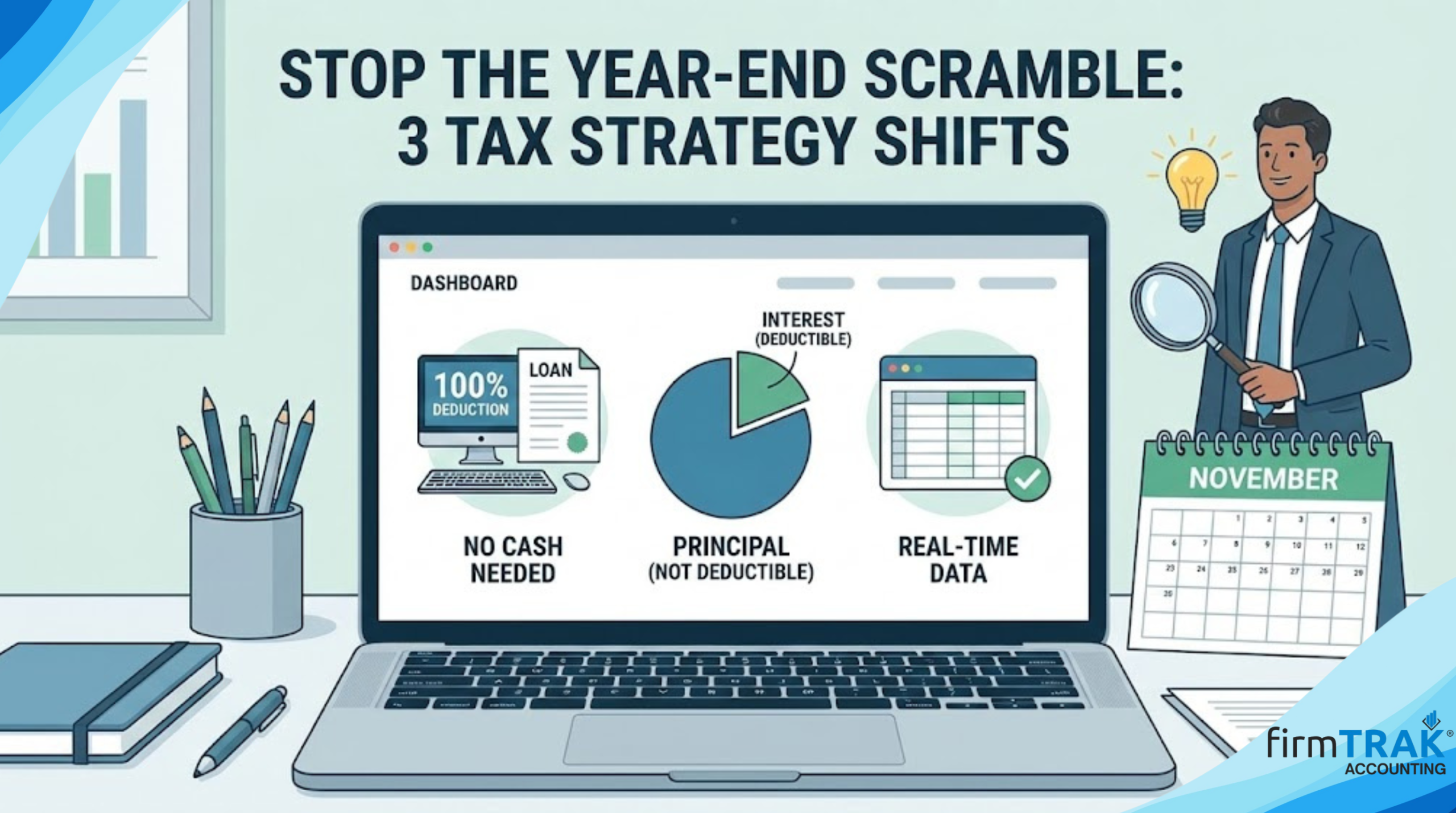
Thanks to tools like bonus depreciation, you can get a 100% deduction for certain assets in the year you acquire them. For example, if you need $25,000 worth of new computers to offset your income for 2025 but don’t have the cash, you can finance the purchase. Even though you haven’t paid for the computers outright, you can still take the full $25,000 deduction in 2025.
The core insight here is that the act of acquiring the asset (the purchase) and the act of paying for it (the financing) are two separate transactions in the eyes of tax law. Transaction one is the purchase: you add a $25,000 asset (computers) to your books. Transaction two is the financing: you add a corresponding $25,000 liability (the loan) to your books. The tax deduction is tied to the acquisition of the asset, not the cash leaving your bank.
As accountant Ryan explained:
You’re basically creating two separate transactions on your books and they they go from there based on the tax rules…
Takeaway 2: Myth: Your Entire Loan Payment is a Deduction. Reality: Only the Interest Counts.
This naturally leads to the next question, which the business owner in the discussion immediately asked: what happens in the following years with the loan payments? Like many owners, his initial thought was that the entire payment must be a write-off. The accountants were quick to clarify this critical, and often misunderstood, distinction.
It’s critical to understand that your loan payment consists of two distinct parts:
Principal: This is the portion of the payment that reduces your loan liability. Since you already received the full tax benefit upfront via bonus depreciation, paying down the principal is not a deductible expense.
Interest: This is the cost of borrowing the money. The interest portion of your loan payment is a deductible expense that reduces your taxable income over the life of the loan.
If your loan has a 2.5% interest rate, only the small portion of your monthly payment covering that interest is deductible—the rest is simply paying down the principal you already got a deduction for. This is more than just a bookkeeping rule; it’s essential for cash flow forecasting. If you mistakenly think your entire loan payment is lowering your tax bill, you will be in for a nasty surprise.

Takeaway 3: Your Most Powerful Tool is Proactive Bookkeeping
This brought Richard to his personal “aha” moment: while tax tactics like bonus depreciation are powerful, they are only effective if you have the information needed to use them. The ultimate financial strategy isn’t a secret loophole; it’s having real-time, accurate information about your business’s performance.
Consider these two scenarios Richard described:
The Old Way: Waiting until February of the next year to reconcile all income and expenses from the previous year. By then, it’s too late to make any tax-saving moves.
The New Way: Having up-to-date monthly reporting that provides a clear picture of your profit and potential tax liability before the year ends.
This timely insight is what transforms you from a passive observer to an active strategist. When you know where you stand financially in November, you can make an informed decision to purchase that new equipment and take advantage of bonus depreciation. Without that data, you’re flying blind.
Richard perfectly described the feeling of being powerless without current data:
…it’s almost like I’m watching a crash happen in front of me and there’s not a thing I can do about it because I don’t know what my financial picture is for 2025 until the next February…
Conclusion: From Reactive Panic to Proactive Planning
The key to reducing your tax liability and making smarter business decisions is shifting from a reactive, year-end panic to proactive, year-round planning. By understanding that acquiring an asset (Takeaway 1) is separate from paying for it, and that only the interest on that payment is deductible later (Takeaway 2), you can see why real-time bookkeeping (Takeaway 3) is the linchpin that makes these powerful year-end decisions possible.
Understanding that you can finance a major purchase and still claim an immediate, significant tax deduction is the first step. Pairing that knowledge with timely financial reporting empowers you to take decisive action that can fundamentally change your company’s financial outcome for the year.
Now that you know what’s possible, what one decision could you make before year-end to change your financial future?

The $18,000 Health Insurance Shock: 3 Reasons Your Premiums Are About to Explode

The annual health insurance open enrollment period is a familiar source of anxiety over rising costs. But for millions of Americans—especially small business owners and individuals on the open marketplace—the price increases for 2026 are not just a routine bump. The routine bump is about to become a financial earthquake that will force devastating decisions.
——————————————————————————–
Reason 1: The Sticker Shock Is Unprecedented
For many, health insurance costs aren’t just rising; they are set to more than triple. The scale of this increase is staggering. Take the example of Karen Whis Kwakowski, a small business owner in Illinois and partner at Firm Track Solutions. Her monthly premium for full coverage health insurance for 2026 is jumping from just under $400 to an astonishing $1,500—a stark increase she describes as 150%.
This translates to a new annual cost that can cripple a household budget. As Karen notes, the financial burden is immense:
“…if I want full coverage health insurance it’s going to cost me $1,500 a month…which means that that totals out to $18,000 annually”
This is not an isolated incident. Ryan Alman, another small business owner and Karen’s partner at their firm, is facing a similar reality. His household’s monthly premium is doubling from around $500 to $1,100. An unexpected expense of this magnitude doesn’t just destabilize a budget; it shatters it, forcing families to question everything from their savings to their homeownership.
Reason 2: The Federal Safety Net Has Vanished
A key reason for the jump is the expiration of federal subsidies. The Affordable Care Act (ACA) provided enhanced subsidies that could reduce out-of-pocket costs by as much as 75% for those with qualifying incomes. For the 2026 plan year, those subsidies are now gone.
This change particularly affects individuals and households earning around or over $60,000 annually, who now receive no tax relief and must absorb the full, unsubsidized cost of their insurance premiums. The one-year extension on these enhanced subsidies was not included in subsequent federal budgets, causing them to expire as scheduled.
The result is a policy failure with direct and painful consequences for millions, as Karen reflects:
“I think that it’s a it’s a real shame that this this healthc care policy has failed but fail it has”
Reason 3: Market Competition Is Disappearing
In some states, a lack of competition is making a bad situation worse. Illinois serves as a clear case study. Following the folding of Health Alliance, an insurance provider in the state, Blue Cross Blue Shield has been left as a virtual monopoly.
This lack of competition is directly connected to the dramatic price increases seen in the state for 2026. When consumers have few or no alternative insurance providers, they lose all leverage. This leaves people like Karen forced to consider “catastrophic” plans, which cover only hospitalization, and to meticulously “keep track of your receipts” for any potential tax deductions, as every dollar now counts.
This monopoly power becomes particularly devastating in the absence of federal subsidies. Without that financial cushion, consumers are left completely exposed to the whims of a single provider with no incentive to control costs.
——————————————————————————–
Conclusion: An Open Question for America
For 24 million Americans, the open marketplace is no longer a safety net—it’s a trap. A convergence of failed policy, vanishing competition, and expiring subsidies has created a perfect storm, with household budgets directly in its path. This is not just a financial issue; it is a crisis that will force households to make painful choices between their healthcare coverage and other essential costs.
The situation has created a fundamental uncertainty about the future of affordable healthcare in the country. As Ryan frames the challenge ahead, the system itself is called into question:
“…the future of healthcare in America is now open question because who knows who knows how many people are going to be able to just come up out of pocket at a doubling or tripling of their their actual their prior year rates”
With the current model proving untenable for millions, the pressing question is no longer if the system will break, but what a viable, competitive, and truly affordable healthcare future for America must look like.

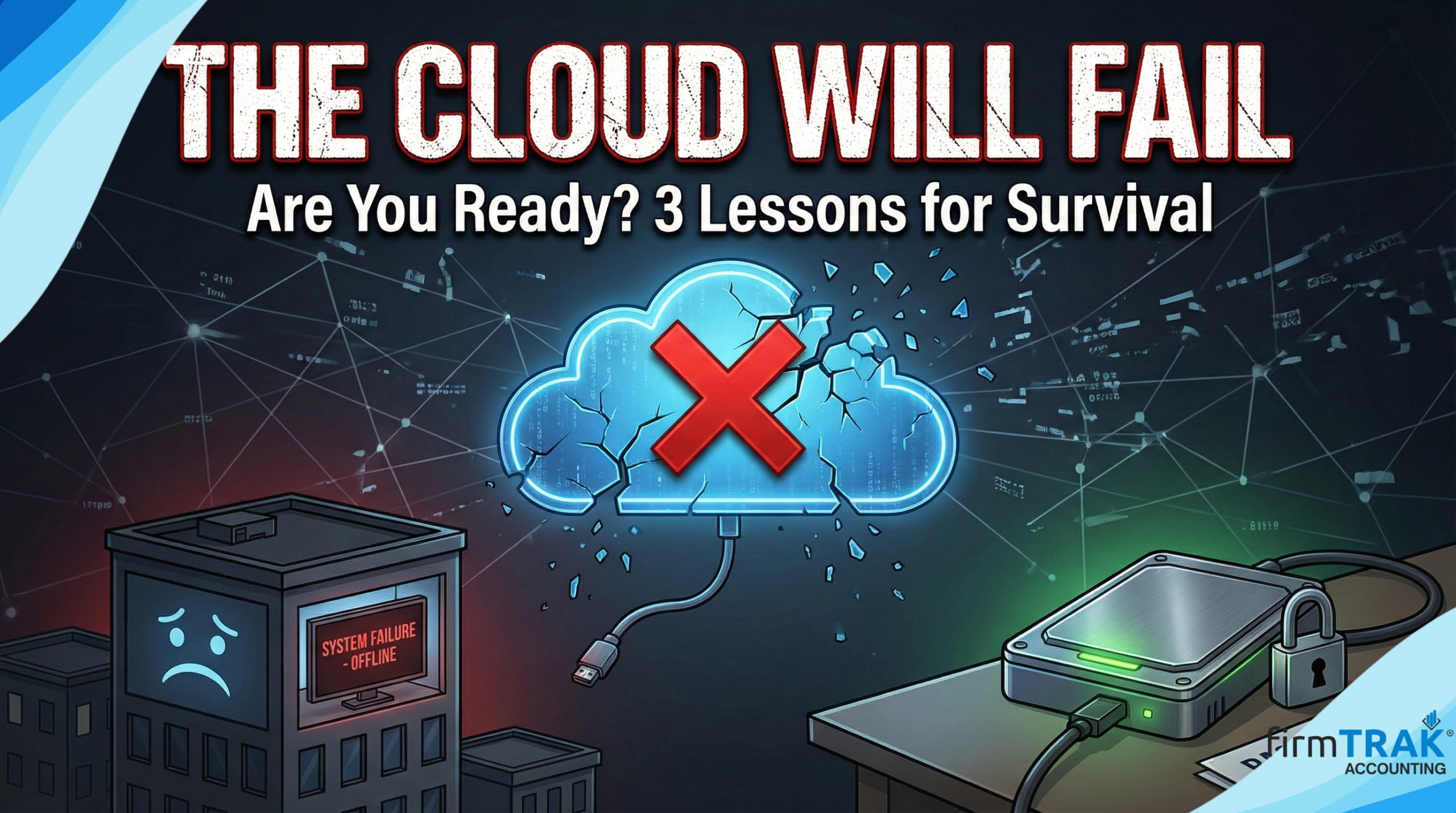
The Cloud Will Fail: 3 Lessons from the Annual Outage You Can’t Afford to Ignore

1. Introduction: The Familiar Feeling of Digital Disconnection
It’s a feeling that has become as predictable as the seasons: you try to access a critical file, log into a service, or launch an application, and nothing happens. A quick search reveals the culprit—a major cloud provider like Amazon Web Services (AWS) is experiencing a massive outage, and a significant portion of the internet has gone down with it. It’s a “Groundhog’s Day” scenario that plays out annually, reminding us of the fragility of the digital infrastructure we depend on.
While these events are often short-lived, they serve as a powerful, real-world stress test for our data safety strategies. The purpose of this article is not just to rehash the news of another outage but to explore the critical, and often counter-intuitive, lessons these disruptions teach us. For any business, especially small ones, understanding these takeaways is essential for building true digital resilience.
2. Takeaway 1: “99% Uptime” Still Means Your Business is Closed for Three Days a Year
Cloud service providers love to advertise impressive uptime statistics like “99%,” which sounds nearly perfect. However, when you translate that percentage into actual business hours, the picture becomes far more alarming. A standard full-time work year consists of 2,080 hours. A 99% uptime guarantee still leaves 1% of the year—or over 20 hours—as potential downtime.
For a small business, 20 hours of being unable to access core systems, client data, or operational tools is a critical vulnerability. To put it in more practical terms, that’s the equivalent of being completely shut down for nearly three full workdays. When your entire operation relies on these cloud-based backbones, even a statistically small outage can have an outsized impact on your productivity and bottom line.
3. Takeaway 2: Your Only Real Safety Net is an Offline Backup
The core lesson from these recurring outages is that relying solely on one type of system, no matter how robust it seems, introduces a single point of failure. The most effective strategy to counter this risk is simple and timeless: back up your key files and systems to an external drive that is not connected to the internet.
This isn’t just a recommendation for the non-technical; even Carin, one of the firm’s partners who works daily with cloud-based systems, noted that she immediately turned to a backup system during the outage. This proactive mindset is becoming more critical as major tech companies push users deeper into cloud dependency. For instance, with the rollout of Windows 11, Microsoft makes it increasingly difficult for users to store files locally instead of on OneDrive. This default setting makes a conscious, manual offline backup strategy more essential than ever.
For professional organizations like law firms, this strategy is doubly important. It not only protects the immense amount of hard work already invested in client matters and cases but also preserves the strict confidentiality that clients depend on, keeping sensitive information insulated from widespread internet disruptions.
4. Takeaway 3: The Experts Are Surprised It Doesn’t Break More Often
The architecture of the modern internet is surprisingly fragile. A vast ecosystem of businesses, from small startups to global enterprises, often relies on a single provider like AWS. This consolidation of services means that one failure can have a cascading effect across the entire digital landscape. According to a recent Wired article on the subject, the real surprise isn’t that these outages happen, but that they don’t happen more frequently.
As one analysis noted, the experts behind these massive platforms have a sobering perspective on their own creations:
“their sort of overall theme of their article was they’re surprised it doesn’t happen more often. So take that for what it’s worth that a mega corp like Microsoft and AWS. They’re like, I’m surprised it’s up as much as it is, but it shouldn’t have taken them as long to fix it as it as it did.”
This insight is a stark reminder for small businesses. The issue isn’t just that the cloud can fail, but that recovery can be unpredictably slow. If the very architects of our digital world are surprised by its stability and critical of its recovery time, relying on their systems without a personal safety net is not just a risk—it’s a gamble.
5. Conclusion: Use Downtime as a Wake-Up Call
Ultimately, these annual outages should be treated as more than just a temporary inconvenience. Each disruption is a free, real-world fire drill—a valuable opportunity to see where your vulnerabilities lie. Instead of waiting for the next crisis, use this latest outage as a catalyst to “reevaluate your plans.” This reevaluation should also include a call to your insurance provider to understand what, if any, coverage you have for business interruptions caused by third-party outages.
By understanding the real-world meaning of uptime percentages and embracing the simple security of an offline backup, you can protect your business from the inevitable moments when the cloud fails. Ask yourself a simple question: If the cloud disappeared for a week, would your business still be standing?

Setting Your Rates: Pricing Strategies for Professional Services Firms

Introduction

Setting a price for your professional services can be difficult and complicated. While maintaining your competitiveness in the market, you want to make sure that your pricing accurately represents the value you offer to clients. This post will walk you through the process of determining your prices, going over several approaches to pricing, how to set up fees, and when to raise your charges. After reading this, you’ll be more knowledgeable and capable of selecting the best strategy for your company.

  1. Determine Your Fee Structure

It’s crucial to define your cost structure before delving into certain pricing tactics. One of the three main charge models is typically utilized by professional services firms:

  • Hourly billing: A conventional method involves billing clients according to the number of hours they labor. Although this approach is simple, it may not be the most flexible when it comes to growing your business.
  •  Flat prices: Offering clients cost consistency, flat prices may be a more alluring choice for them. But determining the appropriate flat rate necessitates having a solid grasp of the job involved.
  • Value-Based Pricing: This strategy bases your rates on what your clients believe they are getting for their money. Frequently, it results in a win-win scenario where customers are content to pay for the value they receive.


  1. Pricing for Value

Value-based pricing is gaining popularity in the professional services industry because it aligns your fees with the impact you make on your clients’ businesses. To implement this strategy:

  • Understand the Client’s Perspective: Get to know your client’s business goals, challenges, and the value they expect from your services.
  • Align Your Pricing with Value Delivered: Set your fees based on the positive impact you can make on the client’s bottom line.
  • Communicate Value: Clearly communicate how your services contribute to the client’s success and justify your fees.


  1. Different Pricing Models

Let’s now examine some various pricing strategies that will assist you hone your strategy:

  • Retainer Model: Your services are continuously accessed by clients for a set monthly price, which guarantees a consistent flow of income.
  • Project-based pricing: This works well for clients with clearly defined, time-bound needs as it involves charging a one-time price for a particular project.
  • Tiered Pricing: To accommodate a range of customer needs, provide several price tiers. This enables customers to select a service level that fits within their spending limit.
  • Subscription-Based Model: Charged on a monthly basis, clients pay a charge that is akin to retainers but may contain a predetermined amount of hours or services.


  1. Increasing Rates Over Time

As your firm grows and gains experience, you should consider raising your rates. Here’s how to do it effectively:

  • Assess Market Conditions: Keep an eye on market trends, competitors’ rates, and economic factors that could influence your pricing.
  • Communicate with Clients: Be transparent with your existing clients about rate increases, providing ample notice and discussing the value they’ll continue to receive.
  • Offer New Services: As your firm evolves, introduce new, higher-value services that can justify higher rates.
  • Gradual Increases: Rather than making sudden jumps in rates, consider implementing gradual, incremental increases over time.

Conclusion

An important part of your business plan is determining the appropriate pricing for your professional services company. Understanding your charge schedule, matching value to price, and selecting the best pricing model will help you draw in new business while maintaining the health of your company’s finances. Remember that a normal aspect of business growth is a gradual increase in rates. You’ll be well on your way to success in the professional services industry if you use these methods.

10 Must-Have Elements in Business Management Software: A Look at FirmTRAK

In the current fast-paced business environment, managing several aspects of a company may be challenging. It can be aided by business management software. A powerful and all-encompassing software solution can enhance decision-making, boost output, and simplify processes. However, given the variety of available options, it’s critical to identify the essential qualities that company management software must possess. In this blog post, we’ll go over ten elements that are a must-have for any business management software and demonstrate how firmTRAK may assist you in achieving these objectives.

  1. Integration Capabilities: Effective corporate management software must have strong integration capabilities since they allow for easy collaboration with existing tools and systems. It must enable data synchronization and real-time collaboration, eliminating the need for manual data entry and reducing errors. Strong integration capabilities provided by firmTRAK guarantee easy data transmission between numerous systems and give businesses a thorough view of their operations.
  2. Customizable Dashboard: For organizations to quickly access key information, a dashboard that is both user-friendly and adaptable is essential. An overview of important metrics, performance indicators, and data visualizations should be given. firmTRAK provides organizations with a highly adaptable dashboard that they can customize to meet their own requirements, ensuring quick access to pertinent facts and facilitating informed decision-making.
  3. Financial Management: A robust finance management area is a must for all business management software. It should have features like budgeting, invoicing, spending tracking, and financial reporting. firmTRAK’s financial management solutions help businesses track income and outgoing expenses, produce accurate financial reports, and streamline their overall financial workflow while managing their money effectively.
  4. Customer Relationship Management (CRM): A CRM system must be efficient in order to maintain strong customer interactions. Thanks to the software, businesses should be able to manage customer data, keep track of interactions, and automate sales and marketing activities. A comprehensive CRM module from firmTRAK helps businesses manage leads effectively, cultivate customer connections, and streamline sales and marketing operations.
  5. Project Management: A strong project management function is crucial for companies that perform project-based work. It ought to make task management, teamwork, resource allocation, and tracking of progress easier. Businesses can efficiently plan, carry out, and monitor projects thanks to firmTRAK’s project management capabilities, which also ensure optimal resource use and prompt task completion.
  6. Inventory Management: For businesses that handle project-based work, a competent project management function is essential. It should make task management, collaboration, resource allocation, and progress monitoring simpler. Thanks to firmTRAK’s project management skills, businesses can easily plan, carry out, and monitor projects. These capabilities also ensure optimal resource use and fast task completion.
  7. Human Resource Management: A strong HR management function makes it easier to handle tasks like employee onboarding, payroll processing, performance evaluation, and leave tracking. It should also allow for the management of employee records and efficient internal communication. firmTRAK’s HR management tools help businesses streamline their HR processes, automate time-consuming tasks, and ensure efficient staff management.
  8. Reporting and Analytics: To help firms make the most of their data, business management software should have robust reporting and analytics functions. There should be access to sophisticated analytics tools, data visualizations, and customizable reports. Organizations can rapidly evaluate their data, see trends, make fact-based decisions, and improve performance thanks to firmTRAK’s reporting and analytics solutions.
  9. Mobile Access: In the modern mobile-driven environment, business management software must offer mobile access. Employees should be able to access crucial functions and data when traveling in order to ensure productivity and flexibility. The firmTRAK mobile app allows businesses to access their management software from any location, enabling remote work and seamless collaboration.
  10. Scalability and Security: A firm management system should also prioritize data security and be scalable to support business growth. Strong security measures, data encryption, and user access controls should all be included. FirmTRAK concentrates on data security while providing scalability to match the changing needs of enterprises. It does this using sophisticated encryption techniques and stringent access limitations.

In conclusion, the success and growth of every firm depend greatly on the careful selection of appropriate business management software. Businesses can find a software solution that meets their unique requirements by taking into account the ten important factors that were previously discussed. All these crucial operations are included in the entire business management software package provided by www.firmtrak.com. firmTRAK’s capabilities can be used by businesses to improve efficiency, streamline processes, and promote growth. Find out more about firmTRAK and to view the complete range of our services. To improve your company management skills and keep current on industry trends, follow us on our social media channels.