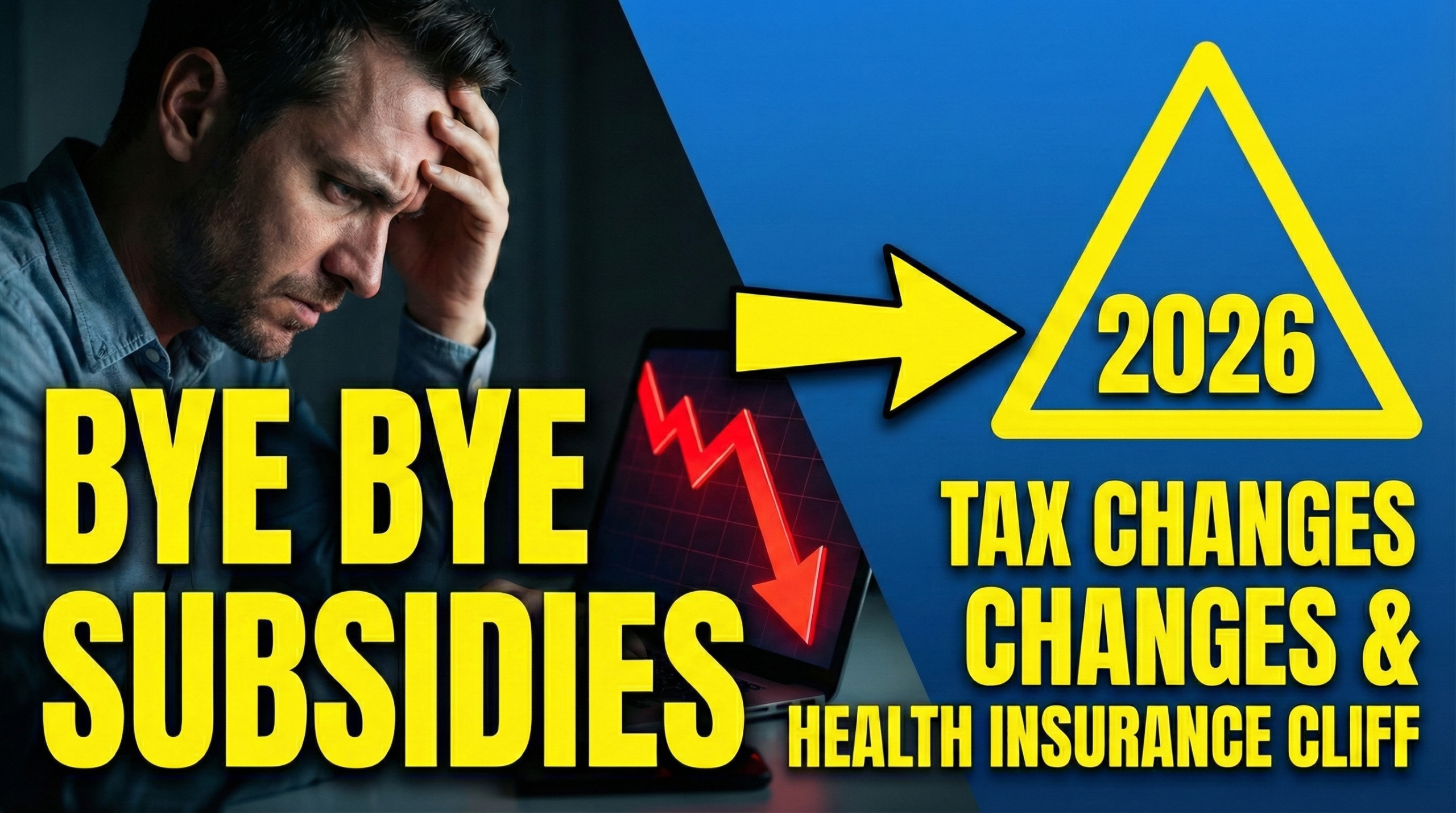
The era of “easy” tax planning is dead. For years, small business owners have navigated a relatively stable landscape, but as Ryan Oltman of Firmtrak puts it, “another day in paradise” now means preparing for a massive legislative shift.
A recent report from Accounting Today details the sunsetting provisions of what some have dubbed the “big beautiful bill,” and for the unprepared, the results will be anything but attractive. We are approaching a 2026 tax cliff that will fundamentally change how health insurance subsidies function. If you are waiting until 2025 to adjust your strategy, you are already behind. To protect your bottom line, you must listen to the warnings coming from the experts at Firmtrak—Ryan Oltman, Carin Weiss-Krolikowski, and Richard Marvel—who are currently mapping out the “net swing” maneuvers that separate the winners from the losers in this new era.
The $60,000 “Benefit Cliff”: Why Your Private Plan Is About to Get Expensive
The most immediate threat to middle-to-high-earning entrepreneurs is the “phase-out” of health insurance subsidies for private-pay plans. Under the upcoming 2026 changes, the IRS is reintroducing a hard “benefit cliff” that targets individual earners.
The math is brutal: if you are an individual making more than $60,000 annually and you purchase insurance through the marketplace rather than an employer-sponsored plan, your subsidies could vanish entirely. This isn’t a gradual decline; it is a total loss of financial support that will leave thousands of business owners footing a massive, unexpected bill.
“Subsidies for private pay are changing,” warns Carin Weiss-Krolikowski. “If you make more than $60,000 as an individual, those subsidies vanish. You must plan for 2026 now, especially if you are not already covered by an employer plan.”
The Business Ownership Advantage: Marketplace vs. Internal Plans
For the self-employed, the choice between the public marketplace and an internal business plan is no longer just a matter of preference—it’s a high-stakes financial decision. Richard Marvel, a Firmtrak partner and law firm owner, recently stress-tested these two paths to find the maximum tax advantage.
The Math of the “Net Swing” Why are we talking about a $30,000 to $35,000 “net swing”? It comes down to the cumulative power of technical tax positioning. Consider a single business owner whose monthly health premiums exceed $1,000. That is a $12,000 to $15,000 annual top-line expense.
If you pay this personally, you’re using post-tax dollars and losing your subsidy at the $60,000 income mark. However, by running that insurance through the business, deducting it at the corporate level, and properly excluding it from your personal taxable income, you preserve your subsidies while lowering your tax bracket. When you combine the tax savings with the preserved subsidies, the total financial impact hits that $35,000 mark. This is the difference between thriving and merely surviving the 2026 cliff.
The “Bookkeeping Gymnastics” Required for 100% Deductibility
You cannot simply pay your insurance premium from your business bank account and call it a “tax hack.” The IRS requires specific “bookkeeping gymnastics” to ensure these premiums remain 100% deductible for the business and tax-free for the owner.
According to Richard Marvel, the structure of your “books” is what triggers the benefit. If your accounting is sloppy, the IRS will reclassify those payments as a personal draw, killing your deduction and increasing your tax bill. To qualify, you must execute two non-negotiable steps:
- Chart of Accounts Precision: Your system must be meticulously structured to track health insurance premiums and medical expenses as distinct business-coded entities.
- W2 Integration: This is the critical failure point for most S-Corp owners. To satisfy IRS requirements, these premiums must be reported appropriately on your W2. This is the only way to ensure the business gets the deduction while the individual avoids paying income tax on the benefit.
“There are specific bookkeeping requirements that must be met for premiums to be deductible at the business level and excluded from personal income tax,” says Richard Marvel. “Go back to your bookkeepers today. If your structure isn’t set up to capture these medical expenses and report them on your W2, you are leaving money on the table.”
Preparation is the Only Protection: Finding Your 2026 Roadmap
Complexity is the enemy of the unorganized. The 2026 changes are imminent, and the “status quo” is a recipe for financial disaster. If your current bookkeeping staff is confused by the concept of W2 health insurance integration or the $60,000 individual subsidy cliff, you are at risk.
A “good set of books” is the only foundation for 2026 survival. If you lack a clear accounting solution that can handle these nuances, the time to seek professional guidance is now—not when the tax laws have already shifted.
Conclusion: A New Era for Small Business Finance
The 2026 tax cliff will penalize the stagnant but reward the strategic. By restructuring your health insurance strategy and moving away from the marketplace toward a business-internal model, you can turn a potential $35,000 loss into a massive competitive advantage.
Your 2024 books are the foundation for your 2026 survival. Don’t wait for the cliff—call Firmtrak today and ensure your business is structured to win.
Is your current bookkeeping robust enough to handle the 2026 benefit cliffs, or is your business heading for a $35,000 tax surprise?