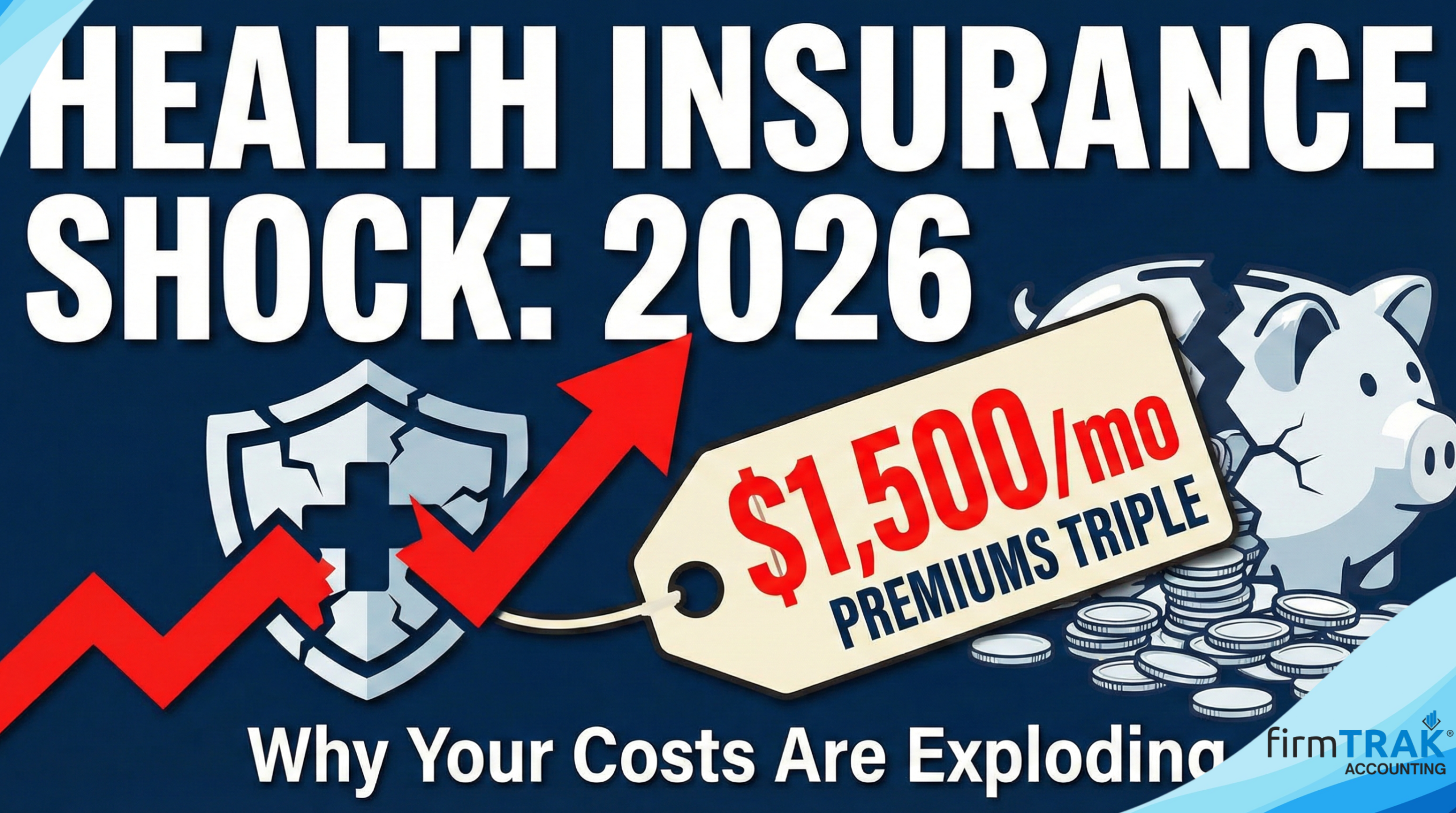
The annual health insurance open enrollment period is a familiar source of anxiety over rising costs. But for millions of Americans—especially small business owners and individuals on the open marketplace—the price increases for 2026 are not just a routine bump. The routine bump is about to become a financial earthquake that will force devastating decisions.
——————————————————————————–
Reason 1: The Sticker Shock Is Unprecedented
For many, health insurance costs aren’t just rising; they are set to more than triple. The scale of this increase is staggering. Take the example of Karen Whis Kwakowski, a small business owner in Illinois and partner at Firm Track Solutions. Her monthly premium for full coverage health insurance for 2026 is jumping from just under $400 to an astonishing $1,500—a stark increase she describes as 150%.
This translates to a new annual cost that can cripple a household budget. As Karen notes, the financial burden is immense:
“…if I want full coverage health insurance it’s going to cost me $1,500 a month…which means that that totals out to $18,000 annually”
This is not an isolated incident. Ryan Alman, another small business owner and Karen’s partner at their firm, is facing a similar reality. His household’s monthly premium is doubling from around $500 to $1,100. An unexpected expense of this magnitude doesn’t just destabilize a budget; it shatters it, forcing families to question everything from their savings to their homeownership.
Reason 2: The Federal Safety Net Has Vanished
A key reason for the jump is the expiration of federal subsidies. The Affordable Care Act (ACA) provided enhanced subsidies that could reduce out-of-pocket costs by as much as 75% for those with qualifying incomes. For the 2026 plan year, those subsidies are now gone.
This change particularly affects individuals and households earning around or over $60,000 annually, who now receive no tax relief and must absorb the full, unsubsidized cost of their insurance premiums. The one-year extension on these enhanced subsidies was not included in subsequent federal budgets, causing them to expire as scheduled.
The result is a policy failure with direct and painful consequences for millions, as Karen reflects:
“I think that it’s a it’s a real shame that this this healthc care policy has failed but fail it has”
Reason 3: Market Competition Is Disappearing
In some states, a lack of competition is making a bad situation worse. Illinois serves as a clear case study. Following the folding of Health Alliance, an insurance provider in the state, Blue Cross Blue Shield has been left as a virtual monopoly.
This lack of competition is directly connected to the dramatic price increases seen in the state for 2026. When consumers have few or no alternative insurance providers, they lose all leverage. This leaves people like Karen forced to consider “catastrophic” plans, which cover only hospitalization, and to meticulously “keep track of your receipts” for any potential tax deductions, as every dollar now counts.
This monopoly power becomes particularly devastating in the absence of federal subsidies. Without that financial cushion, consumers are left completely exposed to the whims of a single provider with no incentive to control costs.
——————————————————————————–
Conclusion: An Open Question for America
For 24 million Americans, the open marketplace is no longer a safety net—it’s a trap. A convergence of failed policy, vanishing competition, and expiring subsidies has created a perfect storm, with household budgets directly in its path. This is not just a financial issue; it is a crisis that will force households to make painful choices between their healthcare coverage and other essential costs.
The situation has created a fundamental uncertainty about the future of affordable healthcare in the country. As Ryan frames the challenge ahead, the system itself is called into question:
“…the future of healthcare in America is now open question because who knows who knows how many people are going to be able to just come up out of pocket at a doubling or tripling of their their actual their prior year rates”
With the current model proving untenable for millions, the pressing question is no longer if the system will break, but what a viable, competitive, and truly affordable healthcare future for America must look like.